> ## Documentation Index
> Fetch the complete documentation index at: https://raindrop.ai/docs/llms.txt
> Use this file to discover all available pages before exploring further.
# Introduction
> Raindrop is the monitoring platform for AI agents. Similar to how Sentry tracks errors in your web apps, Raindrop discovers silent agent failures in production.
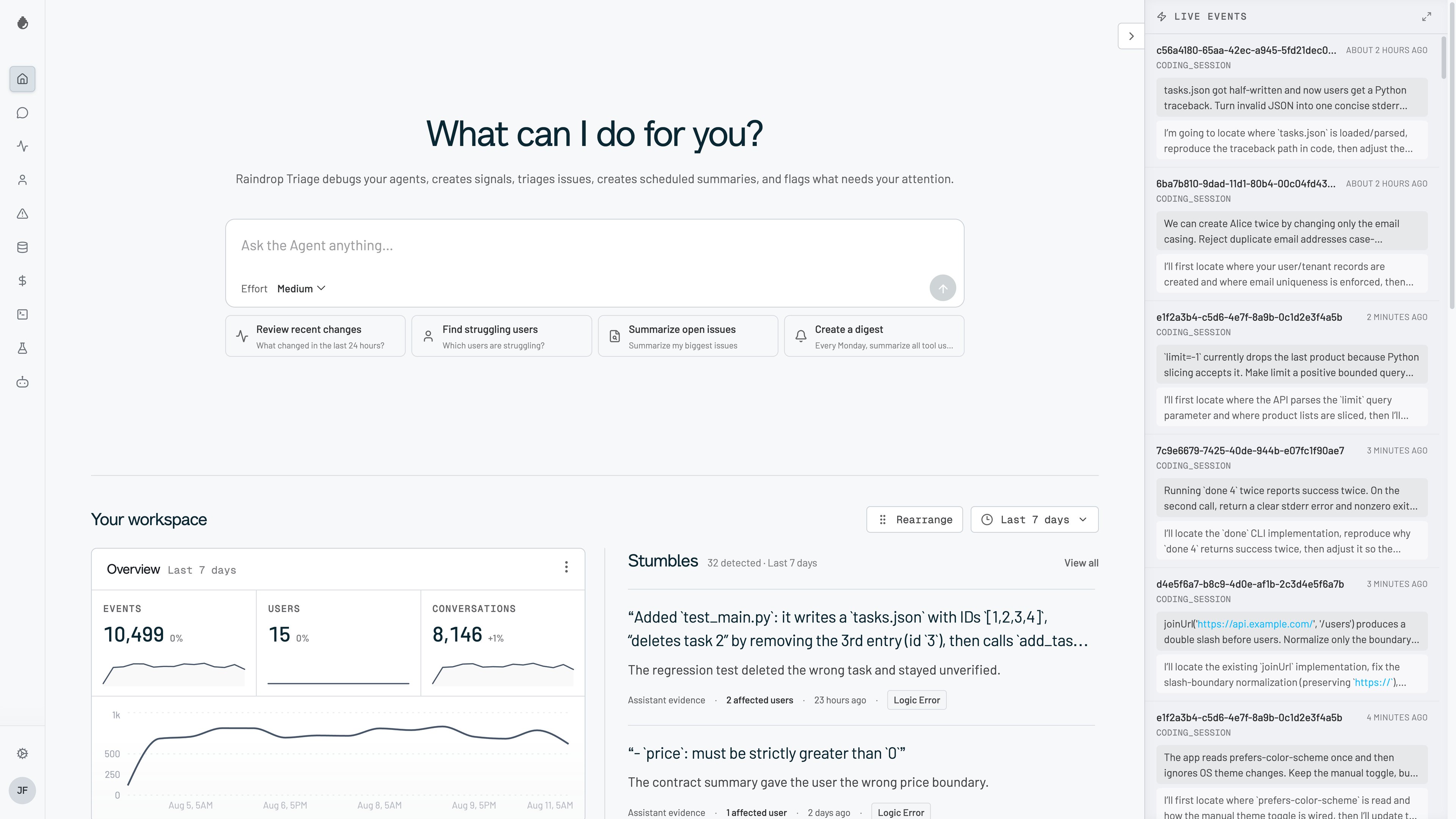 AI agents fail differently than traditional software. A 500 error is obvious. An agent that confidently gives wrong information, forgets what a user said 3 messages ago, or takes a bad path fails silently, invisible to traditional monitoring.
Raindrop helps you:
* **Visualize agent trajectories**: see every tool call, error, and recovery in seconds
* **Detect issues automatically**: choose from presets that catch forgetting, user frustration, and task failures
* **Search across millions of interactions**: find issues in production data with natural language
* **Track custom signals**: define any signal you care about (syntax errors, aesthetic complaints, an agent stuck in a loop) and track it at scale
* **A/B test your agents**: run experiments to validate that fixes actually worked
## Quickstart
Run this in your project directory:
```bash theme={null}
curl -fsSL https://raindrop.sh/install | bash -s -- --cloud
```
It installs the `raindrop` CLI and runs `raindrop cloud setup`, which:
1. Signs you in to Raindrop in the browser.
2. Writes your org write key to `./.env` as `RAINDROP_WRITE_KEY`.
3. Installs the [`raindrop-setup` and `raindrop-investigate` skills](/docs/integrations/skills) and the hosted [MCP server](/docs/mcp/overview) into your coding agents (Claude Code, Cursor, Codex, and others).
Then run `/raindrop-setup` in your coding agent. It finds your AI call sites, instruments them, and checks that events reach Raindrop.
To send events to a specific [project](/docs/platform/projects), append `--project `. Setup then prints a prompt to paste into your coding agent in place of `/raindrop-setup`, and the skill writes the slug into your SDK call. The **Get started** page in the dashboard gives you this command with the project already filled in.
Prefer to wire it up yourself? Pick an SDK or integration below.
## Integrate Raindrop
Full-featured SDK with tracing support for Node.js and edge runtimes.
Native Python SDK for FastAPI, Django, and other Python frameworks.
RESTful API for any language or platform.
Connect Raindrop with AI frameworks, cloud providers, and developer tools.
## Core Features
Ground truth indicators for agent performance. Track wins, failures, and custom behaviors across all your interactions.
An agent that investigates your AI agents in Slack, on the web, and as an MCP.
Automatic detection of broader distribution changes worth investigating.
A/B test your agents to validate changes. Compare models, prompts, and configurations.
This documentation is built and hosted on [Mintlify](https://mintlify.com), a developer documentation platform.
AI agents fail differently than traditional software. A 500 error is obvious. An agent that confidently gives wrong information, forgets what a user said 3 messages ago, or takes a bad path fails silently, invisible to traditional monitoring.
Raindrop helps you:
* **Visualize agent trajectories**: see every tool call, error, and recovery in seconds
* **Detect issues automatically**: choose from presets that catch forgetting, user frustration, and task failures
* **Search across millions of interactions**: find issues in production data with natural language
* **Track custom signals**: define any signal you care about (syntax errors, aesthetic complaints, an agent stuck in a loop) and track it at scale
* **A/B test your agents**: run experiments to validate that fixes actually worked
## Quickstart
Run this in your project directory:
```bash theme={null}
curl -fsSL https://raindrop.sh/install | bash -s -- --cloud
```
It installs the `raindrop` CLI and runs `raindrop cloud setup`, which:
1. Signs you in to Raindrop in the browser.
2. Writes your org write key to `./.env` as `RAINDROP_WRITE_KEY`.
3. Installs the [`raindrop-setup` and `raindrop-investigate` skills](/docs/integrations/skills) and the hosted [MCP server](/docs/mcp/overview) into your coding agents (Claude Code, Cursor, Codex, and others).
Then run `/raindrop-setup` in your coding agent. It finds your AI call sites, instruments them, and checks that events reach Raindrop.
To send events to a specific [project](/docs/platform/projects), append `--project `. Setup then prints a prompt to paste into your coding agent in place of `/raindrop-setup`, and the skill writes the slug into your SDK call. The **Get started** page in the dashboard gives you this command with the project already filled in.
Prefer to wire it up yourself? Pick an SDK or integration below.
## Integrate Raindrop
Full-featured SDK with tracing support for Node.js and edge runtimes.
Native Python SDK for FastAPI, Django, and other Python frameworks.
RESTful API for any language or platform.
Connect Raindrop with AI frameworks, cloud providers, and developer tools.
## Core Features
Ground truth indicators for agent performance. Track wins, failures, and custom behaviors across all your interactions.
An agent that investigates your AI agents in Slack, on the web, and as an MCP.
Automatic detection of broader distribution changes worth investigating.
A/B test your agents to validate changes. Compare models, prompts, and configurations.
This documentation is built and hosted on [Mintlify](https://mintlify.com), a developer documentation platform.